Showing posts with label listening. Show all posts

Wednesday, 16 March 2022

Mark Trezona (in memory and celebration)


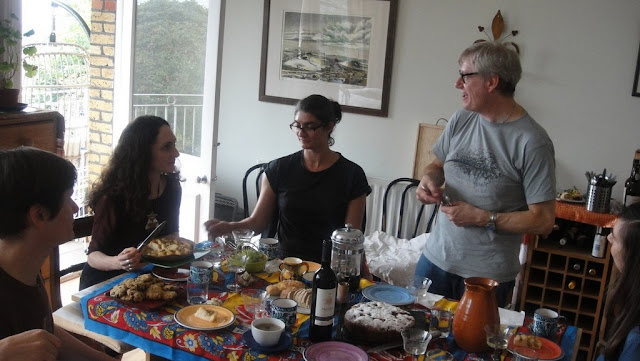
photograph: the end of a lunch party -- colourful table with a cake, bottle of wine, and various plates, jugs, glasses, cafetiere. there are five people around the table, and they look relaxed and engaged in animated conversation. the lunch party takes place in a home, with a door open to a bright balcony behind the table, and pictures on the walls. the people in this photo are: Theron Schmidt, Lucille Acevedo-Jones, Helena Suárez, Mark Trezona (who hosted this lunch and is standing up in the photo), and Sheila Ghelani.


My dear friend Mark Trezona died suddenly at the end of last year. His was not the only death that arrived with shock and sadness during 2021. Indeed, the news arrived at the end of a year that brought grief on so many levels, repeatedly. But there arrived with his death something else – a feeling that propelled me to write this.

I wondered what this particular feeling of loss was, how to articulate it. My partner suggested that it was the feeling of losing chosen family. And I think that’s something of it. Mark was indeed part of my family, and an important part. But there was something more to this loss: Mark, I later realised, was also part of my lineage – one of those people who quietly and generously offered me the tools I needed to survive, as a freelancer, as a listener, as a human.

Though I haven’t seen Mark for a number of years, those tools he offered still serve me every single day. I carry them with me now, and know them as mine. So I’m writing this as a way to celebrate Mark, to mourn his loss, and to acknowledge the strength of energetic resonance that remains with me from the many gifts he offered. And more broadly, I am also writing this to acknowledge what a great difference we can make for each other, to encourage each of you to know how much you make a difference, and to celebrate those people in all of our lives who gently have our back even when they might seem far away.

*

Here are some things I can tell you about my experience of Mark.


He cared about care. He took the time to host beautiful lunches as part of our working relationship, recognising that making and sharing food should be at the heart of how we interact as humans. We joked during those years that one of the foundations of our working practice was cake (but we were also very serious about it!)

He didn’t care if his success looked like other successes. He really was prepared to do things differently, and to lead with his heart. Sometimes wildly impractical (and unafraid of figuring out what was needed to make the impractical doable!) but above all committed to being present and generous with those around him. He believed that humans could be happy, and he worked to share this belief in a wide variety of contexts, always open to learning and growing as he went.

He taught me some really big truths about boundaries and generosity. He taught me that there is a version of selfishness that is generous, that is about inviting each person to take responsibility not just to show up, but to show up with honesty about where they are at and what they need – and that knowing when you can’t show up is a core part of this work. He helped me understand the flip side to this too, that there is a version of generosity that is selfish, where we spread ourselves thin, keep showing up without having the energy or resources to follow through – and this version of generosity is pervasive, and can be dangerous. Together, and later separately, we worked to create models of professional practice based on these truths, inviting care and listening into the heart of every meeting we had.

Once, when I was in the height of striving for ‘career success’ as an artist, I remember asking Mark about a piece of writing he was working on. I wanted to know whether it was finished yet, as I was keen to read it. He said something that I found extraordinary. He said that he hadn’t managed to finish it yet, in spite of repeated deadlines and a desire to get it done, and that he was trying really hard to pay attention to his own reluctance. At the time, I was surprised and slightly puzzled by what he said, but now it makes a lot of sense to me. It is, among other things, a counter narrative to the vicious cycles of pseudo-efficiency that dominate many of our worlds, distracting us from the things we care about. Sometimes, we are procrastinating because our bodies are guiding us with wisdom. Listening in, we can find what is needed. It’s a far kinder and more interesting way to approach procrastination than the usual punitive approach that many of us take on by default.

These are just a few things that I learnt through my relationship with Mark – a relationship that was clearly and explicitly always about friendship as well as work. He helped me trust my instinct that work relationships could also be heart relationships. And at the core of this was his ability to listen, to really listen, to whoever he was with.

 *

I remember talking to Mark about loss some years ago, right before we closed the performance company we ran together. It was during a sweet, intimate gathering that marked the closing of the company but was also a ritual for endings more generally.

During the evening, Mark confessed to me that he didn’t usually acknowledge endings. He said he preferred to keep living, to keep moving. He didn’t like saying goodbye. And in the moment that we were having that conversation, he said that something shifted for him. He was emotional thinking about the ways in which he had avoided goodbyes in his life.

I wanted to end with this story because it is poignant to me. I wanted to end by acknowledging that Mark found loss difficult to deal with, and he recognised this. And in honour of this moment, I want to invite us to be with our losses, with the feelings of holding on or letting go, and the feelings of moving on or avoidance, acknowledging that these are all ways of being with our grief.

Thursday, 2 December 2021

this joy

photograph of a drawing of a dragon-bat with a golden body and colourful wings, flying down towards the words of the blog post, with a golden sun to the left and small waves scattered around. there are bits of paper covering up writing around the dragon bat which contains personal information


For a long time now, I’ve been wanting to write something about joy. Joy that is filled with ease and acceptance of self and other – and the strangeness that cultivating this joy and ease should feel like resistance work for many of us.

Specifically, I’m thinking today about trans joy, the joy of living in a body that is in deep and intimate relationship with change. And I’m thinking about that phrase ‘trans joy’ and the fact that when I said it out loud for the first time to a dear friend, they whispered: “Why does that phrase feel … taboo?”

Some months ago, I promised myself I would write this blog post the day before going in for a joyful surgery. So here I am, keeping my promise. Tomorrow, after many delays and obstacles, I’ll go into hospital for top surgery. It feels good to write this short post from this moment - not only as a communication, but also as intention, an energetic joy burst in itself.

Having said that, the impulse to write this is not only to share a feeling of joy. It’s also to describe the shadow that accompanies the joy. To put it into words as a way of acknowledging it. And having acknowledged it, to dispel its power.

The experience of carrying joy and shadow together is a kind of embodied dissonance. It’s the feeling of aligning with one’s own joy when that joy is deemed inappropriate or illegitimate. When we have maps inside us that tell us that the feelings of joy must be hidden, must be wrong. When the narrative of joy is less palatable to a general public than the narrative of suffering.

It all sounds so familiar. I could be writing about any number of social categories of human life that are deemed less worthy right now. In this moment, I am writing about trans joy. But really, I’m just writing about joy. Joy as aligned with movement, breath, reciprocity, and spirit. Joy as the right to be fully alive in oneself, and accepted. And how stupidly rare it feels.

From the moment I first thought about having top surgery, it felt like a thing of joy. It feels like a gift, a treat, a thing that is just for me.* And yet, when I use those words, I am shamed for them, because there is a social contract that says that trans surgeries must be narrated as arising from suffering: if you are suffering enough, you deserve to have the surgery. If you are tuning into the joy of what it will feel like to be more aligned with yourself, then your story is illegitimate and illegible.

In telling you my story I want to be clear that I’m not attempting to speak for others. There are people who feel desperately unhappy, and who would describe surgery as a means of survival – and the language of suffering that they use is real - the suffering is real. But what feels clear to me is that the unhappiness they are describing doesn’t begin inside. It begins with the violence of gendering. It begins with disregard for listening cultures. It begins with the stifling illusion of fixed and binary identities. In other words, the unhappiness is rooted in the stories we tell.

So I swim in the world like I have a right to exist. As if we all had a right to exist, in our bodies, changing, growing, learning, challenging what was and what we thought was fact. I recognise this joy as resistance. And at the same time, I claim it as real.


All for now.

rajni.x.


line drawn image on scrap of paper, of three animals, one is hippopotamus like, one is bunny rabbit like, and one is whale like, but they are each their own thing. hearts emerge from the mouth of the hippopotamus like, and text reads: everyone deserves love

 
*I want to be absolutely clear here that I am not denying that trans surgeries are necessary or essential for wellbeing. I know that this language can seem like it renders the surgeries non-essential, and this is absolutely not my intention. They are essential, life-giving, and life-saving. And they could and can be joyful.

Monday, 19 July 2021

Going into the Difficulty


[TLDR: This blog post is a long and involved exploration of the complexities around having published a book that includes a chapter with focus on someone who has since been identified as an abuser.

But perhaps you are simply here because you were looking forward to reading my book, Experiments in Listening, but then realised it contains mention of Chris Goode, and are having second thoughts.
If so, here are some options for you!

If you want to read Experiments in Listening, but would feel triggered by reading the part that mentions Chris, then you have two options. There are a series of five zines that contain preludes from each of the chapters, and are a friendly option for encountering the main ideas without going into the fine detail. These are available (free) for print-at-home from the my website, and contain no mention of Chris or his work. Alternatively, if you want to read the book as a whole (thank you for your deep curiosity! please feel free to use discount code RLFANDF30) but you want to avoid the parts where Chris is mentioned, you could skip, or navigate with self-care, pages 169-219. ]


image of a dark landscape, with blurry trees on the horizon, from the cover of Rajni's book Experiments in Listening

TW: brief mentions of suicide, child harms


This is a blog post that involves some detailed questioning around Chris Goode, his life and death, and my friendship with him. If you don’t care about those things, or if reading about those things will feel harmful to you, please don’t continue. This writing is part of my process of working through the complexities of the situation I find myself in, as someone who was friends with Chris for many years, and who worked with him on a project of my own fairly recently. I am sharing it in case it may be resonant and helpful for anyone else.

Specifically, this writing comes as a response to the following situation.

I have just published my first full-length book, called Experiments in Listening, which I’ve been working on one way or another since 2013. It was supposed to go to print in 2019, got delayed, had to change publishers, and I finally signed off on it at the end of April this year. The book details some of the work I did between 2013 and 2016 in which I began to feel into my own understanding of the relationships between listening, performance, and being. Specifically, it details (in a slightly academic mode) my own journey towards understanding the ways in which human encounters always take place across difference, and the possibilities that being-in-audience (as an explicitly attentive mode of being-with) might offer as a form of resistance to dominant voice-centered, presentational ways of being.

Between the time when I signed off on the manuscript, and the time of its publication, someone who plays a role in the final chapter of the book died by suicide. That person was Chris Goode.

For those who don’t know already, Chris killed himself after he was arrested on possession of child sexual exploitation material. Since then, more and more of the story has come out, and the story is one of harm and abuse - Chris was abusive in his working relationships, groomed young men, and was addicted to watching pornography in which young children were being harmed. He never repented for these behaviours, and in fact consistently tried to justify them under the banner of queerness and within his own performance works. Now that he is dead, and a fuller picture of the harms he caused is becoming known, some people in the industry are calling for all traces of his works to be destroyed, in order for him to have no legacy.

Chris was a friend of mine for about twenty years. In the fifth and final chapter of Experiments in Listening he is framed explicitly as a friend. Since the book was already at press when this news came out, there was nothing I could do to reframe this within the book itself. So this blog post is partly a working-through of what it means to publicily declare friendship with someone who is now known as an abuser. And it is partly a reckoning with this moment in time, asking the question: what does it mean to move forward from here?

In some ways, this is a follow up to the blog post I wrote when I first heard about Chris’ death. It is written with deep faith that we can move forward from here, together. But only if we centre care, love, and slowness, for ourselves and for others. And only if we are prepared to embrace the complexities and challenges of doing that work.


Experiments in Listening

The backstory is this.

In 2013, I had decided to abandon my career as a performance maker.* I don’t think I knew why exactly, but I understood that my relationship with something I had always thought would be core to my identity (making performance) was coming to an end. It was a long goodbye, and it felt deeply sad. But I knew it was important to trust the process that was unfolding.

Before I had a chance to figure out what my new life might look like outside the constraints of being a career artist, something extraordinary happened. Someone showed up. That person was Gerry Harris, a professor at Lancaster University who knew my work as a performance maker, and asked whether I would consider doing a PhD as a way of reflecting on the work I had made over the past 14 years, and as a way of processing my decision to leave.

I was very unsure about this invitation. I had already been to university as an undergraduate, and it struck me as the kind of place where I decidedly did not belong. I had also just walked away from one industry and wasn’t very interested in entering another. And yet, the idea of spending three years in dialogue with Gerry was appealing. And it was a funded position. So I applied. I was accepted, and got the funding. And I decided to trust that this was the path I was meant to follow.

It was a ‘practice as research’ PhD, which meant that I would need to do some of the thinking through performance practice rather than only through writing. Initially, this felt like it would be in conflict with my desire to move away from performance-making. But I soon realised that this could be an opportunity to examine the parameters of what I had been calling ‘performance’. And this is how Experiments in Listening (the name of a project, which I later borrowed for the title of the book) was born.

Experiments in Listening was a project that I had been dreaming in some form for years. It was about inviting two people who were friends to be together, in a state of listening, while being witnessed. It was about bringing together familiarity and strangeness. Today I would frame it as a project that was about bringing our internal and external selves into dialogue. The project relied on me working with performers who were experienced enough to be comfortable with ‘not-doing’ in front of an audience, and with whom I was comfortable enough to call ‘friend’. The three people I invited to work with me were Karen Christopher, Andy Smith, and Chris Goode.

The project involved me spending a week working with each of the three friends, a week in which we attempted to do nothing more than be attentive – to each other, to the room, to what might arise when we were not prescribing it. Alongside us each time was a filmmaker, who was present in the room, doing their own listening with a camera. Later, I held a series of sharings during which audiences brought their own listening to the three films that had been made in those rooms. Each dialogue had a different filmmaker, and for the dialogue with Chris, Griffyn Gilligan (who Chris and I had at the time just recently met, but would go on to become Chris’ husband) was the filmmaker.

*

Skip ahead. On the night of my PhD viva, I held a screening of the three Experiments in Listening films, for my examiners and a public audience. In that audience was someone who would carry me through the following years, someone who would later become part of my chosen family. At that time, we had only recently met, and were about to begin a creative mentoring relationship.

Some days after the screening, we had our first mentoring session together. That day, this person asked me why I had chosen not to work with any people of colour for Experiments in Listening. I will never forget that moment. I was stopped in my tracks. I fumbled around for an answer. I said that it was because I didn’t have any friends who are also performance-makers and people of colour and who would be the right fit for this project, and this was because I had grown up inside a performance-making scene that was very white. To some extent, it was true. But another answer to this same question was: because it didn’t even occur to me that this would be important. The truth that finally came into view for me in that moment was that, although I had been interrogating identity politics at surface level through my work for many years, I had never taken the time or had the courage to work through my own internalised racism. In the years that followed, I began this work. It is ongoing and will last a lifetime.

So why mention this here? Because this story, the story of how I came to confront my own internalised racism, and began to reorient my world, is part of the story of Experiments in Listening and part of the story of my friendship with Chris.

During those week-long dialogues, during the screenings, and during the writing of the book, I was very slowly starting to understand the ways in which my lack of internal rigour had led to default worlds around me. I started to understand the extent to which it was structural racism that forced me to leave the theatre/performance industry. And I started to realise, too, that I have the capacity to create the worlds I live within.


Chapter Five of the book, the chapter that is about Experiments in Listening, begins with the following paragraph:

“[I]f listening, as I am proposing it, is a gathering of bodies and of attention, then it seems at best inadequate and at worst dangerous for that gathering to happen without an acknowledgment of the histories and geographies that have shaped those bodies and their capacity for attentiveness. […]

The main players in this chapter—Karen Christopher, Chris Goode, and Andy Smith—have all already appeared as writers in previous chapters, where, slightly uncomfortably but according to academic convention, I have referred to them by their last names. In this chapter, they come back on a first-name basis, as performers and friends. Somewhere in here, among the signs ‘friend’ and ‘writer’ and ‘artist’ and ‘audience’, are human beings with complex identities and emotions, meeting each other in many contexts, across time, and in different places. In this chapter, I ask what happens when we meet each other as complex beings in the context of performance.”

This final chapter of the book includes the beginnings of my realisation that my relationship with Chris could never be reciprocal until we both did the work of addressing the ways in which structural inequities manifest through our bodies.

In June 2019, just under two years before Chris ended his life, we had an email exchange, initiated by Chris, in which I invited us to re-examine default behaviours within our friendship. As part of this exchange, I wrote:

“I have become aware (in part through the project of our dialogue during Experiments in Listening, or rather the beautiful film that Griffyn made) that our relationship has been one in which I bring myself to you, and enter into your world. I have never succeeded in bringing my full self to that relationship. This is on both of us, and I do not expect you to take sole responsibility. I feel we have both inhabited patterns of behaviour that played with power in ways I am no longer prepared to do. […] I am trying to change those patterns.”

I invited Chris to join me in creating a new chapter of our friendship. Chris didn’t tell me directly that he was not prepared to do this work. He indicated that he had heard me, and that we were moving forward with respect and care for each other. I later found out that he had blocked me on twitter, and was spreading false information about me. It has become clear that this was part of a bigger pattern in which Chris was being asked to reckon with his relationship to power and privilege, and was not prepared to, or was not ready to, or was not able to do that work.

I am not sharing this with you in order to demonstrate that I was or am morally superior to Chris, or anyone. These kinds of comparisons feel reductive, and dangerous. I am in a process that I know will last a lifetime, and my own understanding of how to confront these truths is boundaried, as we all are, by my own lived experiences. What I am trying to do is point towards what feels like an important piece of the puzzle – which is that this work happens somewhere between inside and outside. It happens between us, but it also happens inside of us. And those things are not separate.

I draw a line between this story and the worlds within which it occurs. Which means that I am part of the story too. It is our story. They are our worlds. And we are the ones who make them real.


What happens now?

There has been a strong call from some people in the UK theatre industry to destroy all evidence that Chris existed, to write him out of (theatre-making) history. I understand where this comes from, and feel supportive of the need to re-examine and re-write at both a personal and systemic level. I also fully recognise the importance of showing up for survivors in exactly the ways they need. At the same time, I have a fear that these calls for destruction might be where the work of this moment ends, leading us from one dangerous archetype (the figure of the lone genius) to another (the figure of the villain, who can be eradicated, thus eradicating harm from our community). And so this blog post, as well as being specifically about the situation I find myself in relating to my book, is also a call for complexity.

I heard the news about Chris’ death in the same moment that other excavations were happening, literally revealing bodily evidence of the many years of child abuse and genocide that have occurred on the lands that are colonially known as Canada. Evidence of histories that have largely been ignored, in spite of repeated reports and campaigns for justice. The two stories arrived in proximity, and they felt utterly connected. They are both stories about harms that were happening and continue to happen within structures that are upheld by white supremacy. They are stories about what we choose to ignore. And they are stories about the tightly-wound relationships between power, hero-worshipping, and violence. These stories are not in the past. We can’t eradicate them by destroying the evidence that they existed. Our work now is to transform those narratives, and part of that work lies inside us. In recognising our own attachments to those narratives, in recognising that we are part of the stories we tell.

Grappling with my own internalised racism, and other attachments to privilege, is at once the most challenging and transformative work I have ever done. I feel like I am late in starting this work, and I am clumsy as I try to work out what’s needed. It is often devastating, rendering me slow as I work through shame or grief, and it is most certainly not linear. Somedays, it feels hard to justify this internal work, in a world that demands evidence of productivity, in a world that demands immediate evidence that justice is being served. But ever since Chris died, I have felt more certain than ever that this work is important. That it is the most important work we can do.

My book exists without acknowledgment of the series of events that would follow its printing. It occupies an awkward place in this narrative, a kind of strange innocence, of words written before things were known. But the truth is that all of us who knew Chris knew that he played with power. We knew that he was fascinated by harm. Arguably, anyone who was close with Chris for any length of time felt his capacity for harm, and held it together with the knowledge that he also had a capacity for great tenderness.

In the book, describing a scene in the film that Griffyn made, I write:

“In my recollection of this dialogue, Chris and I were caring, careful, and vulnerable, meeting each other on equal terms. Griffyn’s film reveals to me something that I already know in theory, but that is much harder to grasp in practice, which is that—while we might be caring, careful, and vulnerable—we never meet on equal terms, and this must be the starting point for any dialogue.”

I, like many people, spent years filtering out, forgiving, or stepping away from the more problematic moments in my friendship with Chris. This was only possible because I was living and making work inside a system that itself was built through violence, erasure, and extreme gaslighting. Slowly, because slowly is the only way to do this work, I am learning to feel and to notice these patterns in all of my relationships, and to become braver in taking actions to reorient them.

I am not trying to suggest that everyone’s work looks the same as mine. Of course it doesn’t. The whole point of this work is to recognise that we are all implicated differently in these networks of power, violence, and abuse. The call I am making is to recognise the seemingly quiet and internal work of learning to feel again, of listening to self, as part of our collective movement towards freedom. It is complex, confusing, and non-linear. It can feel slow, and it can feel invisible. It is sometimes painful, sometimes impossible, and sometimes, at moments, joyful. It happens at once within and between us. This, I believe, is how change happens.


* I later realised that what I was abandoning was not performance-making or ‘being an artist’ but the uphill struggle of trying to make a career within an industry that upheld patriarchal, capitalist, colonialist values. Abandoning the idea of ‘career’ (i.e. a damaging fiction of linear progression) was the best thing I have ever done, and it eventually left me feeling more like an artist than ever before.


Reading list (some things that inspire me in this work)

We Will not Cancel Us by adrienne maree brown

Living on Stolen Land by Ambelin Kwaymullina

As We Have Always Done (and everything) by Leanne Betasamosake Simpson

Leaving Evidence blog by Mia Mingus  

Catching Teller Crow by Ambelin Kwaymullina and Ezekiel Kwaymullina

Love and Rage by Lama Rod Owens

also:

(on this blog) 'Breaking Open: the work of listening in a racist world'
Monday, 28 September 2020

Breaking open: the work of listening in a racist world


image of dark landscape with sky and clouds - moody and blurry

This is a transcript from a talk I gave last week, to mark the end of my two-year postdoc at Concordia’s Acts of Listening Lab. It was written to be listened to live with an audience, but I hope that something comes through from the written words.

To celebrate the International Day of Listening, join Acts of Listening Lab postdoctoral fellow Rajni Shah as they reflect on two years of research into the work of listening across difference. This talk will include reflections on Rajni’s ‘Listening Tables’ series, as well as personal reflections from their own embodied experiences as a non-binary person of colour living on unceded lands. Those who identify as QTBIPOC are especially welcomed.


Start here:


As a listener (including those who are reading) I invite you to begin by thinking about what it means for your listening to meet my listening, in this online meeting place. This is a slow, somewhat meditative talk. It asks you to bring your listening. So before you go any further, take some time to listen in to your own body. Ask yourself:

What do I need in order to be able to listen right now?


Do you need to be here, reading or listening to this talk? Is now the moment? Perhaps when you tuned in, you found that you need something else right now. If so, please honour that desire.

If now is the right moment, please take one action to help yourself arrive into your own listening. This might be making a cup of tea, running a bath, meditating, changing your location, putting on music, or anything else that will allow you to feel just a little more arrived.

When you’re ready, we’ll begin.


Acknowledgments

I acknowledge that I wrote and recorded this talk as a visitor on Gadigal lands and waters. I offer deep respect and gratitude to Gadigal elders past, present, and emerging, and to all Indigenous peoples around the world who are doing the heart work of continuing and resisting.

I acknowledge the kookaburras and the lizards, and the many other creatures who were close by as I wrote this talk, whose songs and dances teach me about time.

I acknowledge the whales, who are making their passage south as I write this.

I acknowledge my own heritage and blood family, who are from the Kumaoni region in present-day Uttarakhand, India.

And I acknowledge and thank all the people who made the Listening Tables project. Luis, Caite, Andrea, MJ, and Alana at the Acts of Listening Lab. Guest listeners Ellen, Leo, Savita, and Eldad. The listeners who came back each time to share and grow this practice: Emma, Hanss, Seçkin, Victoria, and Ayumi. And all those who attended Listening Tables between August and November 2019.

Thank you.


*


I try to turn things right side up.

Which is the same as to say,

I turn things upside down.

Which is the same as to say,

I try to make sense of the world.

Which is the same as to say,

I tried to rearrange the room in order to rearrange our thoughts,

which is a way of saying,

I invited us to rearrange our minds and hearts by inviting us to rearrange the room, the table,
                                    and our listening.


1. Breaking


The first Listening Table. Tiohtià:ke/Montréal. August 2019.

I am nervous, and newly arrived back on to these lands. I came from unceded Gadigal lands, where I was not invited, and arrived on the unceded lands of the Kanien’kehá:ka Nation, where I was not invited, into the University, where I was invited, but which itself is at the heart of a history of peoples and actions that were not invited.

In any one moment, there are so many arrivals.
Harms done, that continue to harm.
Harms done that continue to be done.

I am aware of this discomfort, the shame of mobility and the histories that enable or necessitate it, the shame of racisms, my own and others, the shame that pours through lineage into our bodies.

On this day, same as most days, I am trying to find new ways to arrive myself.

At the first Listening Table, I was nervous. 30 people arrived. They had, as invited, brought food to share. Their hearts were suddenly right there, beating, in the room, expectant, and to a greater or lesser degree, trusting me to hold their experience. And I was nervous, and this is how it began.

I had arrived hours earlier, more than five hours earlier to set up the room. I like to give myself the time to arrive, see, here I was again, trying to give myself the time and space I needed to arrive. But when the people came into the room, I was nervous, I moved quickly. I remember myself losing the ground beneath my feet. I remember myself not yet feeling arrived from those lands, these lands, the bright sparkling waters and thick air of Gadigal country. Not knowing how to be arrived in that room. Not knowing how to be oriented.

That first table, I had no idea how things would go. I had a plan, of course. The plan was this. During the first hour, in one room, the Acts of Listening Lab, are ten people around a beautiful table. Microphones at the table. Pretty light hanging in the middle of the room. Those people, the ten, mostly strangers to each other, are invited to sit together for a full hour and wait for words to arrive. Those people are invited to meet across difference through listening.

A chance to be heard, and held.
A seat at the table.

And in the other room, the one that is called the Sun Room, the room in which we would be meeting now, in which I’m imagining us all sharing this talk, in the Sun Room are the rest of the 30. There are papered tables, pens and pencils, plants, natural light, cushions, chairs, and headphones through which these people can listen in to the listening conversation that is happening between the ten in the Acts of Listening Lab across the hallway. Later, in the second hour, we will come together, and share food, and share words.

This was the plan. And this is how it went. In some ways, it went exactly to plan.

I began with an introduction. And as part of this introduction, I invited us to enter into a process during which we would, together, select who would go into the Acts of Listening Lab, to sit at the table, and who would listen in from the Sun Room. I said something like this:

“The work of Listening Tables is about reorientation. It’s about the fact that how attention is distributed is political. One way of thinking about it is that it is about what happens when we centre the margins in order to problematise default behaviours. To this end, in considering whether you want to take part in the Table, please ask yourself whether yours is a voice and a body that you see represented in all its diversity in mainstream media, whether yours is a voice that is heard, that has agency in the world. If so, maybe it is your turn to listen in, to take a different role, in order for us to collectively reorient. If yours is a voice that you feel is unheard, unrepresented, placed at the margins, then you might consider stepping up, to take your place at the table, even if this feels a little challenging or takes some bravery.”

I like to make invitations in this way, clear enough that there is an intention that can be heard, but open enough that each person can gather around that invitation in the ways that resonate for them. Rather than me determining which bodies need to sit at the table, the invitation asks each person to determine for themselves which role they will take on that evening. It was an invitation to both listen in and listen out, to place ourselves at the point where those things meet.

What I didn’t say explicitly is that this is an anti-racist practice.

I wondered, in the weeks and months after that first Listening Table, whether I should have been more blunt.

Racism is a blunt tool that presents itself in blunt ways. The work of reorientation, of listening, of figuring out how we might even stand a chance of arriving in a room together, is at once subtle and blunt. It is careful, delicate, difficult work, and it is incredibly simple.

*

I’ve thought about trying to explain to you what actually happened during that first table. The complexities of the listening experiences that presented themselves over those few hours we spent together, and the many obstacles to listening that were present. I’ve thought about trying to explain how some people seemed so aware of their bodies and voices in relation to others, and others seemed not to be aware at all, and how these behaviours fell so devastatingly neatly along lines of racialisation and speaking privilege. But every time I try to put the facts of that evening into words, I get knotted up in the complexity of its emotions. It would take me more than the hour that we have to talk my way into that knot, and then I would have to leave us all knotted up.

Knotted up is a place I’ve been and know.
But I’d rather focus on loosening the knots than recreating them.


What I will say is this.

White supremacy was present with us in that room, during that first table, in all its hard armour.

Unexpressed pain and anger and grief were present, and they obliterated the possibility of listening.

Tenderness was present, as was warmth, trust, and desire.

Harm was done.

Hurt was felt.

And in the midst of all this, solidarity was present, and listening was present.

*

After the first Listening Table, a dear friend asked me: why didn’t you make it a closed space? Why not make it a project for people who identify as Black, Indigenous, and people of colour? My answer is that I love being in BIPOC-only spaces. I seek them out. I love leading for BIPOC communities. I love the places we are able to go together, the trust, the delicacy, the respect, the world-making that happens when we’re not dealing with the assumptions of whiteness. But those can’t be the only spaces in which we are able to express ourselves. They can’t be the only spaces in which we are seen and heard. And they can’t be the only spaces in which we are centered.

What happened during and following that first Listening Table was shattering. It was messy and hard and deeply felt for many people. And I changed things, of course I changed things as the project moved forward and evolved. But I also started to understand something about that shattered place.

I started to understand that this is the work.

I started to understand, to trust, that this is urgent work.

I started to understand how much work it would take.

It is hard work.

It is heart and spirit work.

It takes time and patience and persistence.

It takes trust and vulnerability and not knowing.

And it will always include breaking.


2. Open


It is just over a year since that first Listening Table.

Surprisingly, I am writing this talk from a place of breaking open.

At first, I feel this as an opposition. The task of writing a talk and the task of being with my own breaking open feel at odds. But I am curious to know what will come from this moment of thin spirit, thin skin. So I invite them to be one. I write as one who is breaking open. I write from a place that is in close kinship with the unbearable, with the unbearables. Some humans would call this the work of decolonising self. Some would call it sickness, or failure. Some would call it transformation. And some would pretend really hard that it was not happening.

But it is happening.

I am breaking open.

We are breaking open.

For many years, I did not do this blunt work. I was more subtle, more refined, and more successful. I was much more pleasing to those who needed pleasing, and much more approachable, and much less sensitive. I did everything I needed to do in order to survive. Or maybe, I did everything I needed to in order to help others survive. Or maybe, and I fear this one is the closest to the truth, maybe I did everything I needed to do in order to help systems of oppression stay alive. I hated the idea of finding solidarity with other people of colour, because I did not want to see race. I did not want to see racism. What I didn’t realise was what is now so obvious to me: that I was holding racism in place, and it was destroying me.

*

My parents bet their survival on rationalising the world. I bet mine on feeling it. Such a risky strategy! It leaves me feeling the sicknesses of systems that I carry inside me and am a part of. It leaves me a weak player, a sad and angry player, and sometimes, oftentimes, a non-player. My parents feel contentment, and they wish the same for me. The other day, one of them said to me: “I worry that you’re too focused on the negative. You have to make the best of what is here.”

What they don’t know is that the work I am doing is joy work. It is the work of making room for joy, and feeling joy in this body, as a world-making way of being. Sometimes, it feels like breaking open. Sometimes it feels like battle. Sometimes it feels like being a killjoy. Sometimes it feels like dreaming. Sometimes it feels like I am spinning away into other realms. And sometimes, the best of times, I remember that my joy exists right now, alongside all the other joys and sorrows. Sometimes, I remember that this moment isn’t one moment in a sequence of moments, but one moment in alongside and intertwined with many other moments. Sometimes I remember to unhook myself from the blinkered behaviours I have learnt for survival, and I live in alignment with my joy. Sometimes, this is the work. The work of feeling joy.


what needs saying in this moment?


I want to live in an expanded world where there is room for all of us.

Do you want this too?

But really?

Even if it means destroying what you have built?


what needs saying in this moment?

nothing needs saying. nothing more needs saying. nothing more can be said.

stop trying to speak yourself into the future.

stop trying to mend.

your listening reveals your own boundaries. uncovers the earth. opens up the possibility that you might notice the moon.

your own listening doesn’t even try to be separate from the vibrations of this planet.

your own listening asks for surrender.


what needs saying in this moment?


no more questions.

hold the moment open.

break the moment open.

and stay there.


3. The Work


What does it mean to reclaim that phrase, “the work”?

I take everything that I used to consider ‘not work’ and place it inside that phrase these days.

So breaking open is the work.

Taking rest is the work.

Having a conversation that spills over from where or what I intended, is the work.

Being held is the work.

Saying “I love you” and feeling it is the work.

Intimate friendship is the work.

Saying “no” is the work.

Holding change is the work.

Attending to the pain in my body is the work.

Crying is the work.

Dreaming is the work.

Listening is the work.

*

In my introduction to the first Listening Table, I said: “Let’s trust in the process, let’s trust we are the people who need to be in this room.”

I do believe that we were the people who needed to be in the room. Even the person who told me afterwards that they had a horrible time at the Listening Table, that they hated not being able to talk more, that they felt constrained and attacked and disappointed that they had trusted me. And that they wished they had listened in to their own desire to say “no” instead of feeling compelled by my invitation to show up. I have to trust that this was their work on that day.

I do believe that we were the people who needed to be in the room. I include in this my own inability to arrive, my own chaos and mess, my own desire to hold it all together, and my inability to do so. The ways in which things spilled over the edges and taught me from there.

What fascinates me about attempting to listen with others is that it shows me things I could not see on my own. Or at least, it lets me notice things I have known but didn’t want to know. It is as if in the attempt to listen there is a surface-rising that takes place. Patterns, beliefs, assumptions, violences, histories, inequities float to the surface.

And there they are, announcing themselves, very seriously and very lightly.

“Here we are. Just as we have always been. But this time, you’re listening.”

If we are listening, if we are paying attention, it is almost clumsy, almost funny, how these structural inequities play themselves out. Our histories, our assumptions, our held tongues and polite conversations hold themselves up to us. And we laugh or hate or cry or look away, but they are there.

This is the work.


4. Listening


I think about the Acts of Listening Lab exactly as its name suggests: as a laboratory for listening, in which we conduct experiments in listening. In which we hope to come a little closer to understanding what listening is, and what it might be. In which we practice something called listening. The Listening Tables were conceived from this idea, that there was a place in which some people could come together to explore listening, to examine listening, to listen.

But listening, as I understand it – a practice which some might call ‘being’ or ‘feeling’ or ‘attending’ – listening without already knowing what we are listening to, is a big ask. It’s a big ask in a world that revolves hard around short attention spans, around goal-oriented tasks, around doing and producing and declaring ourselves. In a world that moves fast towards naming, calling out, and acting. In a world that does not value slowness, or multi-generational thinking.

So these attempts to practice listening are often met with resistance.
They are resistant and they create resistance.

Each Listening Table had a guest listener. Someone who had been invited to listen, to bring their listening to the table. This was part of the experiment. Every time I told someone about this idea of a guest listener, they didn’t understand what it could mean. We are so attached to the declarative, to words and their meanings, that it is hard for us to understand what it might mean to bring a listening. When I told people about it, it was almost like I was telling them about a guest nothingness. “But what will they do?” people would ask, those people including some of the guest listeners themselves. “They will listen.” I would reply, but no one could grasp what this could possibly mean. Even after we had these conversations, most people assumed that the role of the guest listener would involve speaking. This tells me a lot about how we value listening and how we value speaking.

A guest listener is someone who is invited to listen.

Someone who is invited to bring their listening, in the knowledge that each person’s listening changes the room, changes the work that can happen in the room.

In the knowledge that listening is work.

That each of us is changing, creating, manifesting the world through our listening.

That each of our listenings are linked.

And indeed, each guest listener brought such a different energy to the table. And not only that, but the fact that the guest listener was different each time changed who was in the room, and how they came into that room. This was most clear when my mum was the guest listener. People came to that table with a desire to meet my mum, or with an expectation of what it might mean to have a parent, an elder, in the room. And my mum is blind, so her listening, her experience of what it means to sit quietly in a room, was shaped by her experience of blindness. And her blindness, and her relationship to me, shaped my own listening, and my own being at that table. At the end of the night, so many people thanked my mum for her presence, for what she brought. And she didn’t understand what she had brought, or what she had done, that had so moved those people. Because it wasn’t her. It was her in relation to all of us, and all of us in relation to each other.

Each of our listenings are linked. In fact, to name them as ‘each’ feels inappropriate to the work of listening. We are creating each other all the time. We are creating our worlds all the time. We are listening each other into being all the time. It is how we orient ourselves. And it is happening, whether we acknowledge it or not.


5. A racist world


[one minute’s silence - listen]


6. A world


for the listeners
for the healers
for the seekers
for the killjoys

for the guests   and the hosts
for the spirits
for the ghosts
for the circles   and the spirals    and the mountains      and the songs

for stumbling
for tumbling
for shattering
for failing
for overflow
for being-with
for holding open
for breaking open
and for shutting down

for saying no
again and again
until it is time to say yes

for the circles   and the spirals    and the mountains      and the songs
for the lizards    and the whales    and the kookaburras    and the ants

for saying no
again and again
until it is time to say yes

for you, who need to hear this.
you know who you are. we know who we are.

Thank you for your listening.

[end]