The thing about the bananas incident is that I could still feel it in my body for weeks after it happened. And it really wasn’t a huge deal. And it probably lasted less than half an hour in all. But it revealed so much to me about how we are seen and how this determines who we “are”. So:
The Bananas Incident
The bananas incident happened seven weeks ago. Since then, small moments have re-created the story for me. It's not an unusual story, but it's unusual that it would be mine. And in owning that story, in holding it as part of my past, it has changed me. But in telling it, in sharing it, in gathering ammunition against it and sympathy for my own view of it, I've left it behind. It has changed my views, but it hasn't changed me. And that's because I'm privileged. I have the privilege of leaving it behind.
The story goes like this.
I was in Mons, Belgium, preparing for a concert with two local musicians and my friend and collaborator Suzie Shrubb. We were there for a week to improvise together, with a concert on the Saturday evening. On Friday night, Suzie had become quite ill, and by Saturday afternoon she hadn’t emerged from her hotel room or texted me, so I headed back from the venue to the hotel, a little worried. Before I left, I grabbed a small packet of bananas that one of the tech team had bought for us – in case Suzie was feeling better enough to eat something.
On the way back to the hotel, I passed through the town centre, and popped into the mini Carrefour to buy a few more things: some crackers, and some chocolate, if I remember correctly. I probably looked a bit tired and worried, and it was really cold so I had my scarf wrapped around my (shaved, brown) head. When I got to the checkout and was putting things away in my backpack, the cashier asked to see what was in my bag. I showed him. He asked me if I had bought the small packet of bananas from the Carrefour and I said ‘no’; then he picked up the packet of bananas and asked another cashier if these bananas were from the Carrefour, and she said yes. At which point I tried to explain (in French) that I hadn’t bought them, and they might be from that shop, but I hadn’t stolen them. But it was too late.
What followed was, you might say, hilarious. At the time it almost destroyed me.
The cashier called another cashier over and told her I had stolen the bananas.
I said that I hadn’t stolen them, and tried to explain what had happened.
She said they would have to check the CCTV footage.
Someone behind me in the checkout line offered to pay for the bananas.
I thanked him but explained again that I hadn’t stolen them.
I offered to leave the incriminating bananas behind.
I offered to pay for the bananas.
I told them I was in a hurry and had to get back to the hotel to see someone who was quite ill, and asked what I could do to make them believe me.
I tried to leave the bananas behind and walk out of the shop.
The cashier came after me and hauled me back into the supermarket.
Finally, the other cashier said she had looked at the CCTV footage and realised I hadn’t stolen the bananas.
I was free to go – no apologies.
The thing is that none of this happened calmly. I felt so trapped in the conviction they all had that I was a thief, and that I had stolen a packet containing two bananas, that I got very worked up – by the end, I’m pretty sure I was swearing, and shouting. I was so hurt by the whole incident, and the reality that was playing out in front of me: that once people see you as a criminal everything you say sounds like a crime. And even more distressing: that if someone was so desperate that they had stolen two bananas from the supermarket, this was how they would be treated.
Most of all, I understood how it felt to be seen as a criminal. I’ve never really understood this before, but I know that it’s an everyday reality for many people. I could feel it in my body for weeks afterwards. And I understood that this kind of situation would only need to repeat itself a few times to completely change not only how I felt in public space, but how I acted. If the space you’re given in the world is to be seen as a criminal, then that’s the space you have to fill.
Me – I went back to my hotel, organised a taxi to take Suzie to the hospital, and then went back to the venue to make some music. I told the story to my friends, and they were shocked at what had happened. Eventually, this was enough to put it behind me.
Showing posts with label translation. Show all posts
Showing posts with label translation. Show all posts
Thursday, 16 April 2015

Tuesday, 1 October 2013
Tributes
It
has been a very long time since I wrote a blog post - so I decided to
embark on a mini-project to rectify the situation. Below are the
long-hand and transcribed versions of a blog post I began on September
22nd and finished on September 26th, using only my left (non-dominant)
hand and writing until I had filled a small notebook. It takes the form
of a series of tributes.


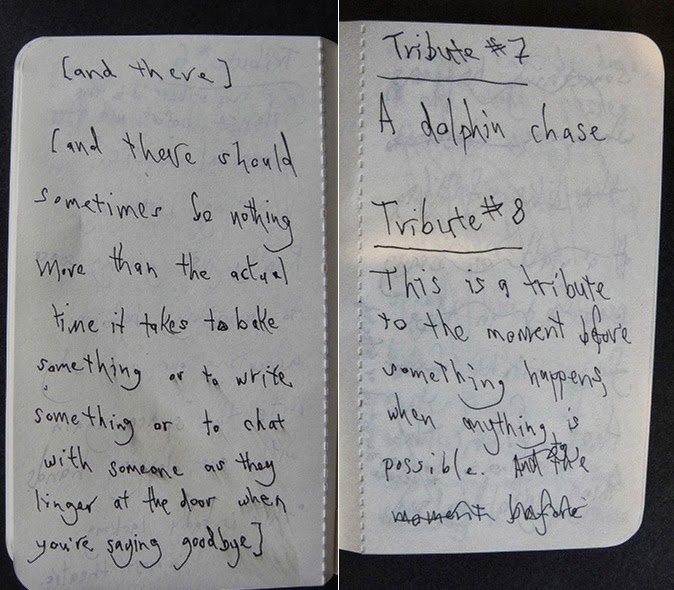


Transcribed:
I have done the thing I promised I would not do. I have unintentionally abandoned this blog. Not that this matters to anyone else. The internet is a sea of abandoned thoughts - and always waiting to be treated as seed in someone else's garden. This is a beautiful thing.
I am writing a left-handed blog post. Because writing in this way (long-hand and with the hand that was not taught) sometimes shakes me free of convention. This is an experiment. I have much to say, and maybe if I write painfully slowly my brain won't take over and edit out everything. Drawing each word. What do you think? I think this could be a terrible idea. But I have a small blue notebook and I shall fill it with left hand thoughts and then I shall transcribe them. And it will be the beginning of *something* no matter how weary or wearisome.
Tribute #1
This is a tribute to Jeremy Hardingham's big pot of stew.
Jeremy was one of the first directors I worked with, on a show called 'Incarnate'. The first time we met as a company, Jeremy insisted that when we were working together in Edinburgh he would make a large stew and this would nourish us all (we were 12). We would share a flat and we would rehearse every day and constantly allow the show called Incarnate to become in the city with its many audiences. But most of all, he would make a stew.
[and you can]
Tribute #2
This tribute is to the big pot of stew again. I don't think I'm finished remembering it.
You see, I'm wondering if there is a way of being in that place again, as people who have been in the world a while. Can we only dream of a big pot of stew when we are unhounded by finding ways to make a living? Or maybe it is just me who is hounded, and who allows myself to be hounded to such an extent. Maybe this is why I am needing to find constraints to the logical brain, like this writing with the opposite hand. Maybe it is only now, having let go of the idea of being a career artist, that I can allow the memories of stew and a rigorous, truly experimental unabashed process to flourish. Or maybe I am just revelling in the memory of having someone else make the stew!
[not deeply or philosophically not in the right order but pointing towards something that matters]
Tribute #3
This is a tribute to the kind people in my dreams.
Do you ever have dreams where someone is just meltingly kind? It happens to me occasionally. It's hard to translate into words. But just as fear or deep unashamed sadness sometimes gathers and becomes manifest in sleep, I sometimes encounter someone who cares deeply. Last night it was the critic Lyn Gardner. But it does not matter who they are. It is the fact that kindness and care also have the capacity to gather and to manifest that I wish to acknowledge. Tension and sickness and anticipation pass through our bodies, and love.
Tribute #4
"HERE AT OVERJOYED WE LOVE ART AS MUCH AS YOU DO.
Overjoyed - your art & craft convenience store."
Singapore
[words fall down the mountain and they look great]
Tribute #5
Here's to the people we see in other people. The people we may never see again but who appear (in a smile, in hair, in someone's posture or gait) in reference to the ones we pass on the street. How it is that sometimes, for a while, someone who has been quite absent in your life, will be referenced several times in your mind, as if the deck of your memory has been re-shuffled.
Or maybe it's a tribute to the people you never actually see, because their only role in your life is to remind you of other people you once knew.
[Those people will always come back. Whoever they are, they will be in your dreams or just stepping off the bus or their neighbourhood will be on the news.]
Tribute #6
This tribute is to the silence before and after classical music.* Waiting. Listening. Really just giving space to something before asserting our own body into the space again with our clapping hands.
*this is sadly lacking in most theatre.
[and there]
Tribute #7
A dolphin chase.
[and there should sometimes be nothing more than the actual time it takes to bake something or to write something or to chat with someone as they linger at the door when you're saying goodbye]
Tribute #8
This is a tribute to the moment before something happens, when anything is possible.
[Why tributes? Shouldn't a tribute take a different form, like a song? Maybe you could write a song]
Tribute #9
This one is for the Seabergs, as in Seaberg Acrobatic Poetry (look them up!).
When Theron and I were leaving Atlanta, we had a small goodbye party at the Ballroom Studios. I consider that time in Atlanta one of the most profoundly instructive moments in my life. I met so many artists whose work would continue to influence me deeply - people like Alice Lovelace, Letta Neely, Gwylene and Jean-Marie Gallimard, Stephen Clapp, Priscilla Smith .. oh too many to name them all, but among them this wonderful older couple called Ronnog and Steve Seaberg. As they were leaving the party Ronnog said, in her very sincere and considered way: "We will miss you. And we will think about you every day." There was a pause, and then Steve added, "Well not every day, but we will think about you sometimes." And then they left.
Tribute #10
And now we are almost done. This one is in tribute to those days. It might be sunny or raining or you might try to recall something that matters, but nothing can take you into the space of being truly alive. It is like just sleeping without sleeping. You try to recall the swans singing at dusk. Or maybe you make yourself write.
[I like it but I think it is a really bad idea.]
Tribute #11
Swans gather in Swedish Lapland at this time of year and they sing the best songs ever. Don't take my word for it. Visit Junosuando. The sky and light and colours and sounds of one long dusky swansong.
[I couldn't work out if I meant tributes or tributaries, I spend a long time with words sometimes]
Tribute #12
This is a tribute to people who are not trying to be clever. By that I mean people who are really curious and really humble.
Tribute #13
This is a tribute to the people who bother to tell you when they appreciated something or when they were thinking of you or even just when they got your message.
Tribute #14
There was a man who used to tap dance outside the Westgate shopping centre in Oxford, every day when I went into town he was there. He played music on an old stereo and shuffled his feet around. He didn't really look up and he didn't really ever lift his feet up, he just did this shuffly dance all day long and there was a hat for money in case anyone wanted to throw some change in.
Tribute #15
This is for friends who write you letters and friends who just stop by to say hi when they're in the hood and friends who sneak into your house when you're at work and make treasure hunts.
Tribute #16
To trampolining. Which gives physical form to all my hesitations and doubts and insincerities and since in this form they cause danger of injury, for this one hour a week I must learn to be sure and clear.
Tribute #17
To Ben and Max Ringham, in whose company I found the desire and the confidence to make music.
Tribute #18
This is a tribute to the man who makes small spheres of silver that are exactly the weight of one day. I found one in my bed last night.
Tribute #19
To languages that are shaped by topography, and confound the way we understand categorisation of the world through grammatical structure.
e.g. See Dr Mark Turin on the Thangmi language
["Whole conceptual, social and ecological worlds open up when you learn to speak and come to understand languages vastly different from your own." Dr Mark Turin]
Tribute #20
To the people who do not let themselves be stopped by fear of looking like a fool.
Tribute #21
To the futility and joy of decluttering.
Tribute #22
I once made a performance called give what you can, take what you need and there was a table in a shopping centre and people sat around and shared things they had brought. Helga Henry brought some hand cream. She said that she had brought it because when her grandmother was dying Helga had given her hand massages and she wanted to offer this to whoever would like one. She was moved to bring this space of tenderness into that huge shiny shopping centre. At the end of a long day, we sat together and she massaged my hands and we talked of death and dying and of what it means to care.
Tribute #23
Here's to being caught off-guard. Here's to being unprepared. Here's to thinking you knew, and finding you don't.
Tribute #24
Here's to the fact that the quietest person I know, after we met for tea recently, sent me a text that read: I hope I didn't talk too much.
[end of tributes]

Saturday, 31 March 2012
Translation of the Glorious lyrics
Below are extracts from a very lengthy and detailed correspondence that I had recently with a wonderful man called Neil Elliott Beisson - who has translated the Glorious lyrics into French for our upcoming Belgian version of the project. I found the correspondence really interesting. It was conducted entirely via email, and without Neil having seen the show.
I love the process of translation, and often use it within a creative process in some way or another - but I've never written lyrics before, and certainly never had someone attempt to translate them into another language! The challenges are not just of sense, but of rhythm and sound and allusion. Neil is a poet, and he dug deep into the process, asking me lots of questions about intention - and I'm really grateful for that.
The dialogue (even in its edited form here) is rather long and might seem opaque to those of you who've not yet seen the show - but I like it being up here as I think it offers an unusual insight into the creative process. I've included some extracts from the Glorious lyrics in English to help make sense of it - however, not all the lyrics we discuss are included (to avoid overload!). If it's helpful, you can download copies of the full lyrics in both languages here. And if you fancy it, you can also read a bit about the Glorious project here.
Dear Lucille, here we are then
Strange how people look at you and
Strange how you can be so present
Even as you draw the line
As you step outside
As you step outside
Dear Sushila, hold them tightly
Feel the past return around as
You are holding onto hope that
even this, all this might change
As you draw the line
As you draw -
Dear murmur
Hold them gently
Hold the weight of knowing people
Hold the weight of staying true
Place your body in this landscape
Know your body in this place
you're a mine of hidden stories
on the lashes of your mind...
Neil
I love the process of translation, and often use it within a creative process in some way or another - but I've never written lyrics before, and certainly never had someone attempt to translate them into another language! The challenges are not just of sense, but of rhythm and sound and allusion. Neil is a poet, and he dug deep into the process, asking me lots of questions about intention - and I'm really grateful for that.
The dialogue (even in its edited form here) is rather long and might seem opaque to those of you who've not yet seen the show - but I like it being up here as I think it offers an unusual insight into the creative process. I've included some extracts from the Glorious lyrics in English to help make sense of it - however, not all the lyrics we discuss are included (to avoid overload!). If it's helpful, you can download copies of the full lyrics in both languages here. And if you fancy it, you can also read a bit about the Glorious project here.
Dear Lucille, here we are then
Strange how people look at you and
Strange how you can be so present
Even as you draw the line
As you step outside
As you step outside
Dear Sushila, hold them tightly
Feel the past return around as
You are holding onto hope that
even this, all this might change
As you draw the line
As you draw -
Dear murmur
Hold them gently
Hold the weight of knowing people
Hold the weight of staying true
Place your body in this landscape
Know your body in this place
you're a mine of hidden stories
on the lashes of your mind...
Neil
In "Song of Letters", in the Lucille stanza, what do you exactly mean by "draw a line" and "step outside"? Is it about a situation in particular?
In "Song of Letters", in the Lucille stanza, what do you exactly mean by "draw a line" and "step outside"? Is it about a situation in particular?
In
the Suchila stanza: "Hold them tightly". What is the "them"
referring to?
More
globally, "the act of unbecoming" is a concept that can be understood
and translated in a variety of manners. What is the meaning closest to what you
have in mind with that line?
Rajni
Song of Letters came from a series of letters I wrote to real people. So, no, the characters are not linked, they are like separate letters that are held next to each other. The only thing linking them is me 'writing' to them in a way.
Song of Letters came from a series of letters I wrote to real people. So, no, the characters are not linked, they are like separate letters that are held next to each other. The only thing linking them is me 'writing' to them in a way.
"draw the line" is like the
expression 'to draw the line' - meaning, to contain something, to put an end to
something. It's about containment really - though of course in English with a
nice double meaning of drawing with a pencil too.
"step outside" again, I guess
this is kind of metaphorical and literal at the same time. It's ambiguous in
English too. I like the literal idea that you step outside of the door of your
house into the wider world - but also step outside of a situation.
"Hold them tightly" - again
(sorry) this is ambiguous. In my mind though, this definitely refers to the
audience (them) as well as perhaps Sushila's family.
"the act of unbecoming" for me is
about letting go, letting things unravel, breaking down of the known self in
order to enter the space of the unknown. Does this help? It's a phrase I've
coined for this show really!
they said: when the land is shaking,
when the earth itself is breaking
there’s a void of hesitation
and you can’t know who to trust
when the earth itself is breaking
there’s a void of hesitation
and you can’t know who to trust
Neil
In
the "Landbreak" song, i'd like to know what you meant by the word
landbreak itself: is it just a reference to an earthquake (wether real or
abstrat)? Or is there a pun intended with "daybreak" since you talk
about the night falling etc? Also, is the past tense in the recurring
"They said" an absolute requisite? It sounds right in English, of
course, but translates weirdly into French unless i also put the other tenses
in past tense too, but i'm afraid it changes everything...
Rajni
"Landbreak" - yes, related to daybreak, and the song does relate to an earthquake, though it also metaphorically relates to what is happening to our society at the moment, this breaking up of everything we thought we knew, this shaking up of societies.
"Landbreak" - yes, related to daybreak, and the song does relate to an earthquake, though it also metaphorically relates to what is happening to our society at the moment, this breaking up of everything we thought we knew, this shaking up of societies.
It is fine to change tense if it makes
sense.
Most lyrics relate to a particular
situation and at the same time refer to the audience and everyone in the
auditorium - this is quite important. So they can be read as relating to a
narrative, but also relating to the narrative that is unfolding before us -
i.e. we are all in a space together, waiting, wondering, sharing something, and
preparing to say goodbye.
Neil
i have a hard time with "on the lashes of your mind". Lashes can have to very different meanings... And none of them will translate litterally, but maybe if you can explain in English i can find some analog metaphor...
i have a hard time with "on the lashes of your mind". Lashes can have to very different meanings... And none of them will translate litterally, but maybe if you can explain in English i can find some analog metaphor...
Think 'eyelashes'. A part of the body, but
one which falls and regrows, and is on the edge, and often associated with
beauty and softness. Also, one can make a wish and blow into the world an
eyelash that has fallen out.
It also sits in contrast to the idea of 'a
mine of hidden stories'. The mine is deep and maybe dark and rich, and the
lashes are high and light and on the surface of the body.
-
"Feel the past return around": the words "return" and
"around" are kind of redundant and i can't help but think there's a
reason for that. Does the around mean that the past comes back to surround, to
envelop the person you're writing to? Should i emphasize on the around? Like
i've translated into French as "feel how the past has come back to wander
about"... Is that close enough to what you had in mind?
Rajni
Glorious has a lot of circles in its structure - so the idea of something coming back around emphasises that - yes - a kind of surrounding/enveloping as well as a circular rather than linear progression of time in a way.
Glorious has a lot of circles in its structure - so the idea of something coming back around emphasises that - yes - a kind of surrounding/enveloping as well as a circular rather than linear progression of time in a way.
Neil
- By "staying true" you mean staying true to oneself? To everyone in general? This will drastically change how i'll translate, and i'm afraid that a generic word phrase like "being sincere" might be too general and far off.
- By "staying true" you mean staying true to oneself? To everyone in general? This will drastically change how i'll translate, and i'm afraid that a generic word phrase like "being sincere" might be too general and far off.
Rajni
Staying true to what you believe in - to yourself, your heart, yes, I think that's the closest.
Staying true to what you believe in - to yourself, your heart, yes, I think that's the closest.
Neil
- "on the brink" means on the verge, on the limits, on the border of... But what about "brinking", a few lines down?
- "on the brink" means on the verge, on the limits, on the border of... But what about "brinking", a few lines down?
Rajni
"brinking" meaning existing in a state of being on the verge really - it's a word I made up! The idea of living on the edge, in a fragile way rather than a dangerous way
"brinking" meaning existing in a state of being on the verge really - it's a word I made up! The idea of living on the edge, in a fragile way rather than a dangerous way
Neil
- "As this place returns around": is it a physical place or more like a mental space? Same as the first question with the accumulation of "return" right next to "around". Oh, and why "return" and not "come back"? Maybe that's the part that escapes my understanding!
- "As this place returns around": is it a physical place or more like a mental space? Same as the first question with the accumulation of "return" right next to "around". Oh, and why "return" and not "come back"? Maybe that's the part that escapes my understanding!
Rajni
See the answer for the first question! And I think it's more like a mental space - but also the idea that through time places and ideas and people change but there's a circularity to that change. AND as I said before, 'this place' definitely refers to the theatre space as well as the mental space. So the way that we keep coming back to being in the theatre (we're in a fictional space but we're also right here, with each other) is important.
See the answer for the first question! And I think it's more like a mental space - but also the idea that through time places and ideas and people change but there's a circularity to that change. AND as I said before, 'this place' definitely refers to the theatre space as well as the mental space. So the way that we keep coming back to being in the theatre (we're in a fictional space but we're also right here, with each other) is important.
Neil
In Landbreak, i'm still thinking about the title, i haven't come up with a solution yet that would paralel the daybreak and an earthquake. At some point you use the word "rupture" which also exists in French. It can be used to refer to the break-up in a love relationship or merely the breaking of something. What did you have in mind writing this? i assume i have to keep it vague, but still... i guess it would help to know...
In Landbreak, i'm still thinking about the title, i haven't come up with a solution yet that would paralel the daybreak and an earthquake. At some point you use the word "rupture" which also exists in French. It can be used to refer to the break-up in a love relationship or merely the breaking of something. What did you have in mind writing this? i assume i have to keep it vague, but still... i guess it would help to know...
Rajni
I think that the idea of rupture could work well - I guess what I like about landbreak is the idea of a landscape changing too (actually the physical land on which we stand) but we may have to take a different route to get to the same feeling in french.
I think that the idea of rupture could work well - I guess what I like about landbreak is the idea of a landscape changing too (actually the physical land on which we stand) but we may have to take a different route to get to the same feeling in french.
-
What about the voices in the distance?
I was thinking about people who won't be
there to see the show. For all of us, there are people, whether alive or dead,
who are not close physically but speak very close to our hearts - and I'd like
for them to be present with us in the room/theatre when we perform.
every now and then
you feel them fly past
everything you knew
all the furniture
all the books you loved
people who cared and
feelings of regret
murmurs of desire
you feel them fly past
everything you knew
all the furniture
all the books you loved
people who cared and
feelings of regret
murmurs of desire
Neil
i have one question: the language is very poetic, with a very strong imagery and is sometimes broken (voluntarily, i suppose, or maybe am i the only person to feel this) by the use of daily-life words like "food" (which sounds ugly in French) or "crockery" or "furniture". Why is that? Was it to ground into tangible reality the abstract concepts in the other lines? The three words i've quoted definitely sound weird. By "furniture", did you mean the actual cupboard, shelves etc, or do you extend the meaning of the word over to anything material that could get in the way of "travelling light" (do you know that "Bag Lady" song by Erykah Badu?)... Other than those abstract questions, i'm pretty happy with how it came out in French...
i have one question: the language is very poetic, with a very strong imagery and is sometimes broken (voluntarily, i suppose, or maybe am i the only person to feel this) by the use of daily-life words like "food" (which sounds ugly in French) or "crockery" or "furniture". Why is that? Was it to ground into tangible reality the abstract concepts in the other lines? The three words i've quoted definitely sound weird. By "furniture", did you mean the actual cupboard, shelves etc, or do you extend the meaning of the word over to anything material that could get in the way of "travelling light" (do you know that "Bag Lady" song by Erykah Badu?)... Other than those abstract questions, i'm pretty happy with how it came out in French...
Rajni
Yes, I love the fact that these very mundane words appear in an otherwise very poetic text. For me, it's actually poetic to have them there. And yes, in my head, it's actual plates and chairs and tables that fly through the air in this song. There is something gently comical about it - but it's important to me that it is grounded in this way, not just ethereal but also about imagining all those actual objects in our lives, and what it would mean to throw them into the air.
Yes, I love the fact that these very mundane words appear in an otherwise very poetic text. For me, it's actually poetic to have them there. And yes, in my head, it's actual plates and chairs and tables that fly through the air in this song. There is something gently comical about it - but it's important to me that it is grounded in this way, not just ethereal but also about imagining all those actual objects in our lives, and what it would mean to throw them into the air.
to break wide open
to shy away
to blinker and canter
to squander the day
to shy away
to blinker and canter
to squander the day
to wander and wonder
to place and displace
to keep it within you
and not leave a trace
to place and displace
to keep it within you
and not leave a trace
- i
have a hard time with "To blinker and canter". In French, they can be
translated by horse-related words, but not as verbs, is that ok? Are they
indeed related to horses or am i missing something? Maybe it's an idiomatic
expression i don't know?
Yes, they are horse- related. In English,
though, we can relate them to a person (though we wouldn't normally, it works
in the poetic context of the song) - does that feel weird in french? too weird?
If so, I'm happy to explore taking another route.
-
"To whittle away" is the work of a craftsman, right? Cutting and
polishing something... Is it a problem if i use two verbs in infinitive form in
French? To emphasize the meticulousness of it?
I think it is fine. It's the idea of slowly
cutting away at something in small bits. The main thing with this song is the
rhythm/rhyme. It should feel really like a list - very same-y - and that builds
and builds in a very simple way.
-
Also, by "Unravel" means to unveil who you are to the world, right?
Mmm, not necessarily. I would think of it
as letting go - sometimes that might mean going crazy, losing a grip on the
world, letting go of one's image. So in a sense yes, and of course it's not
clearly stated, but the idea of stopping holding it all together is important.
As we draw this act to night
as the hills are folded in
As the coloured lights are fading
and our thoughts are packed away
It is glorious
as the hills are folded in
As the coloured lights are fading
and our thoughts are packed away
It is glorious
-
What is the "it" in "It is glorious"? That's the main thing
because it'll enable me to understand the whole song... Is it the fact that the
show meets an audience that is glorious?
Ha ha, this is a tricky question. I think
it's the whole situation that is glorious - yes, in a way, it's the fact that
the show meets an audience, and here we all are, for a moment in time, sharing
this space and these stories with each other.
Hey,
just a quick question before i get into more detail and send you the lyrics
back: what do you mean with "Now that the hills are folded in"? i
understood it as "now that the performance is over and we've packed all
the stage-decorations and all"... Is that correct? The same goes with
"thoughts packed away". i think i get it, but i'd want to make sure!
I guess I should have said: there are no
hills in the show! It's just a phrase I liked, that doesn't particularly makes
sense, but yes is generally referring to the idea of things going to sleep /
packing away.
"i
had doubts about "earthbound" as in being just a being that cannot
fly, or bound as in clearly rooted in the soils?"
rooted in the soils - either really, but
also 'heading towards earth'.
"It
is glorious": i've kept the word itself, for i believe both the English
and French languages give it some sort of grandiose, almost
religious, importance. But instead of an "it", i've gone for a
"everything"... i hope you don't mind!
I'm not totally sure yet - but I'm going to
try it as you have written it! I think my worry is that I would like it to
convey that this, right here, is glorious - and in a way this implies that this
glorious exists in spite of everything that is not glorious in the world. Does
that make sense??
How
about "Nous sommes gloooorieuuuuux"
It
would really refer to "all of us, sharing this moment in this
space"... Yes?
One
last question: about "the hills that have folded in", how about i use
the image of flowers that close at nighttime? So far it's the best idea i've
had...
Subscribe to:
Posts (Atom)